
Review · WALKING TOURS
Bangkok: Chinatown by Night Walking Tour
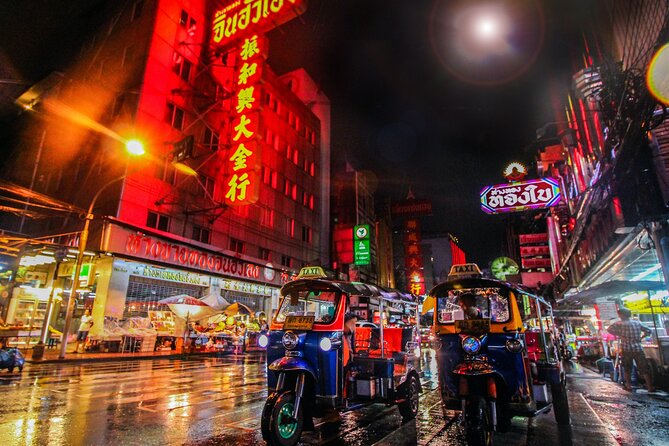
Chinatown at night turns into theatre. You follow a local guide through neon streets and back lanes, with English storytelling that connects what you see to how the neighborhood became what it is today. I like that the walk is short enough to keep your energy up, but packed with memorable spots, from the Chinatown Gate to gold and temple stops.
Two things stand out in a way that matters for your trip. First, the guides like Nam and Dan are praised for mixing clear history with practical food tips, plus real-world help like taking photos and even assisting with navigation apps like Bolt. Second, you get three self-guided walking routes in the Vox City app afterward, so the tour is not a one-and-done experience.
One thing to consider: the price does not include headphones or food and drinks. You’ll be tasting snacks along the way, but you should budget extra for what you choose to buy at street stalls.
In This Review
- Key highlights that make this walk worth your time
- Chinatown by Night: how the 90 minutes click into place
- Meeting at Hua Lamphong exit 1, then stepping straight into Chinatown
- Chinatown Gate and the trade stories that explain the signs
- Gold, pharmacy, and classic storefronts: learning to read Chinatown streets
- Yaowarat Toasted Buns and street food you can actually plan for
- Wat Mangkon Kamalawat: when religion and neighborhood life meet
- Charoen Krung Road, Plaeng Nam Road, and the alley turns that feel local
- Bird’s nest and shark fin signage: how niche products shape Chinatown
- The Mustang Blu and modern contrast, plus a famous name on the route
- Using the Vox City app after the walk
- Price and value: what $18 buys you in a city this big
- Who should book this Chinatown by Night walk
- Should you book this Chinatown by Night walking tour?
- FAQ
- How long is the Bangkok Chinatown by Night walking tour?
- Where do I meet the local expert?
- What language is the tour guide?
- Is the tour food and drinks included?
- Are headphones included?
- What app do I need for the self-guided routes?
- Does this experience include entry tickets to attractions?
- Can I use the pass for self-guided walking tours afterward?
- Is there a cancellation option?
Key highlights that make this walk worth your time
- Hua Lamphong start point: easy to reach by MRT, then you’re already in the action fast.
- Chinatown Gate and trade stories: you connect landmarks to the gold trade and local commerce.
- Street food focus: stops are built around popular eats like Yaowarat Toasted Buns, with dish explanations from your guide.
- Gold shop and traditional business stops: you pass places tied to Chinatown’s trading reputation.
- Temple stop on the route: Wat Mangkon Kamalawat adds a spiritual layer to the neighborhood walk.
- App add-on routes: you can keep exploring with suggested walks after the guided portion.
Chinatown by Night: how the 90 minutes click into place
Night in Chinatown is when the area feels most like itself. The sidewalks get louder, shop signs light up, and the whole place turns into a sensory map. This tour works because it doesn’t ask you to wander until you figure things out. Instead, you walk a defined loop with a guide who explains what you’re looking at, then you keep moving before the streets get too overwhelming.
I really like the timing. Ninety minutes is long enough to feel like you gained context, but short enough that you still have energy to eat dinner after. And because the tour is live and in English, you can actually ask the simple questions that matter on your first night: What should I try? Where do I go next? How do I read what’s on the sign?
There’s also a practical advantage to the meeting point. Starting at Hua Lamphong means you’re not crossing half the city to get to Chinatown. You’re already geared up for a night walk that feels connected to transit, not like a side quest.
More Walking Tours in Bangkok
- Bangkok: City Highlights Temple and Market Walking Tour
★ 4.5 · 3,990 reviews - Bangkok: Grand Palace and Wat Phra Kaew Guided Walking Tour
★ 4.4 · 2,417 reviews - Bangkok: Wat Pho and Wat Arun Guided Walking Tour
★ 4.6 · 1,720 reviews
Meeting at Hua Lamphong exit 1, then stepping straight into Chinatown
You meet your local expert outside the main exit number 1 of MRT Hua Lamphong. That’s a good thing for first-timers, because you’re not trying to decode a Chinatown maze before you even start. Once the group forms, your guide sets expectations and gives a quick sense of what you’ll see, which keeps you from constantly checking your phone.
From the guide feedback, one pattern pops up again and again: they help with more than facts. People specifically praised guides like Nam for making sure everyone can take photos and for being hands-on with practical steps like getting back to a hotel using Bolt. In a neighborhood where the streets can look similar, that kind of support is a real value.
Also, the tour is designed for an audio-assisted self-guided system afterward. You’ll download maps in your preferred language in the Vox City app. During the guided portion, plan to listen, then after the walk you can switch to your own pace with the same navigation style.
Chinatown Gate and the trade stories that explain the signs
One of your early big visual moments is the Chinatown Gate. Even if you’ve seen it in photos, seeing it under night lights gives you a better sense of scale and symbolism. Your guide’s job here is not just to point. They connect the gate to why Chinatown has been a magnet for commerce and migration.
A key theme on this walk is trade history, especially the gold trade. That matters because Chinatown is not just food and shopping. It’s also a place where business routes shaped the neighborhood’s layout and storefront styles. Your guide’s storytelling helps you notice details you might otherwise ignore, like the way certain shops and streets became associated with particular goods.
You also pass older shopfront-style businesses along the way, which helps you read the neighborhood as a working district, not a museum. The night setting adds a bonus. With the lights on, you can more easily spot storefront patterns and the contrast between traditional and newer spots.
Gold, pharmacy, and classic storefronts: learning to read Chinatown streets
The route takes you through a series of stops that feel like a guided course in what Chinatown sells, how it served people, and how that history still shows up on the street.
You’ll visit or pass places such as Chin Hua Heng Gold Shop and get a grounded explanation of the gold trade theme. This is one of the stops where the tour feels most different from a standard walking loop. Instead of only seeing signs, you learn why gold mattered and how that shaped the area’s identity.
Then there’s Berlin Pharmaceutical Museum. The name alone signals something unusual compared to typical street markets, and that’s part of the point. Chinatown night is often presented as food first, but business and culture overlap here. A museum stop in the middle of a walking route makes the neighborhood feel layered, like it has memory, not just energy.
If you’re the type who enjoys history that you can touch, these business stops are a win. You don’t need to be a museum person. You just need to be curious about why certain streets and shop types stayed prominent.
Same stretch of coast, a different sort of day:
- Bangkok: Damnoen Saduak Market and Maeklong Railway Market
★ 4.5 · 26,723 reviews - The Old Siam: Damnoen Saduak and Maeklong Railway Market
★ 4.5 · 10,992 reviews - From Bangkok: Ayutthaya Temples Guided Tour with Lunch
★ 4.7 · 10,535 reviews - Bangkok: Train Market & Floating Market with Boat Ride
★ 4.7 · 9,547 reviews
Yaowarat Toasted Buns and street food you can actually plan for
This tour includes opportunities to taste popular Thai street food, with your guide explaining what you’re eating and how the dishes fit into local preferences. Yaowarat Toasted Buns is one of the named food stops, and it’s exactly the kind of thing that makes a night walk feel worth it. It’s snack-sized, easy to share, and built for eating while you walk.
One thing to keep in mind: food and drinks are not included in the tour price. So treat the food as a choose-your-own-adventure. Your guide will point you toward good options, and the best move is to go with what they recommend, then decide how much more you want to buy based on your appetite.
From the feedback, guides often go further than basic orders. Several people praised guides for making fruit and meal explanations part of the experience, and for steering them toward places they wouldn’t try on their own. I’d use that as your strategy too. Ask what’s best for a first-timer, ask what’s good fresh versus warm, and keep a light stomach for dinner later.
Pro tip: bring cash if you prefer it. The tour doesn’t promise you one payment method for every stall, and night markets often feel smoother with quick transactions.
Wat Mangkon Kamalawat: when religion and neighborhood life meet
Not every Chinatown tour includes a temple stop, and that’s why Wat Mangkon Kamalawat is a standout moment. Temples are where you see how a community organizes belief, celebration, and daily life. In Chinatown, that adds context you might not get from storefronts alone.
Your guide uses this part of the walk to explain what you’re seeing, which helps you avoid the classic mistake of treating religious buildings as just photo backdrops. Even if you’re not focused on architecture, you can still appreciate the atmosphere and the role a temple plays as the neighborhood does business nearby.
This stop also breaks up the intensity of the busiest street segments. After shops and food, you get a calmer rhythm. It’s not a long detour, but it gives your brain a place to reset.
Charoen Krung Road, Plaeng Nam Road, and the alley turns that feel local
After the big markers, the walk shifts into street-level texture. You pass through major roads like Charoen Krung Road and Plaeng Nam Road, then you go into tighter lanes like Nana Tai Alley.
This is where you start to understand Chinatown as a network. Main roads can look like they’re all the same at night, but your guide helps you notice what changes block by block: storefront styles, crowd flow, and where food and commerce concentrate. Side streets and alleys also tend to be more interesting for photos, because the lighting and signage feel more intimate.
The alley sections matter for another reason too. Many first-time visitors try to stick to the most obvious routes. That’s easy, but it often means you miss the quieter street life and the smaller food stalls that run the neighborhood. Guides like Fern and Dan were repeatedly praised for taking people down side streets and up-and-coming areas, which is exactly what you want if you like feeling like you saw the real place, not only the most obvious parts.
Also, one comfort point from reviews is that guides seem to prioritize safety while moving through crowded areas. Some guides were explicitly praised for helping with crossings and for being attentive. On a night walk, that attention changes the experience from stressful to easy.
Bird’s nest and shark fin signage: how niche products shape Chinatown
Two named stops highlight specific trade goods: สยามรังนกทะเลใต้ and Nam Sing Bird’s Nest-Shark Fin. Even if you’re not shopping for these items, they’re useful for understanding Chinatown’s history of specialized markets.
Your guide’s job is to connect these food and product names to the local customs behind them. On the street, signage like this can look random. In context, it tells you how Chinatown developed as a place where people traded not only general goods, but specialty products that carried cultural meaning.
I like how this tour doesn’t pretend everyone will want to try everything. It keeps the focus on context, so even if you skip one tasting option, you still leave with a clearer picture of what the neighborhood sells and why those items appear prominently.
The Mustang Blu and modern contrast, plus a famous name on the route
You also pass The Mustang Blu and Tang Toh Kang 陳焯剛. The tour seems to balance older commercial culture with newer city layers. You see shopfronts, you see streets with strong identity, and then you spot modern additions that signal Chinatown is still evolving.
The Tang Toh Kang 陳焯剛 stop matters because it gives you a named landmark tied to a person or legacy on the street. If you like history that shows up as names and signage, these kinds of stops help you build mental anchors, instead of leaving with only general impressions.
Even when a place is just something you pass by, your guide’s explanation is what makes it click. A good moment here is when you start noticing that Chinatown is not one uniform style. It’s a collage of time periods.
Using the Vox City app after the walk
The guided portion is only part of the value. This Chinatown by Night pass includes three self-guided walking tours in the app, with suggested routes that cover iconic landmarks and quieter streets.
Here’s how I’d use it. After the 90-minute walk, you’re already oriented. Now you can choose what to pursue next based on your mood:
- want more history
- want more food stops
- want landmark shots
The app requires you to download maps by scanning a QR code on your voucher and then selecting your preferred language. Also, the app uses headphones, but you’ll need to provide your own. If you show up without headphones, you might still enjoy the guided portion, but the self-guided piece will feel muted.
This is a smart design for anyone who hates rigid tour schedules. You can let the guide do the heavy lifting for orientation, then you take over.
Price and value: what $18 buys you in a city this big
At $18 per person for a 90-minute English live guide, the value comes from three areas.
First, you’re paying for a human interpretation of a complex neighborhood. Chinatown has layers. Streets can feel similar. A guide helps you connect the dots fast.
Second, you’re getting an app add-on with three self-guided routes. Even if you only use one of them that night or the next day, it extends your money into more hours.
Third, you’re getting built-in food education. Even though food and drinks aren’t included, the tour is designed to point you toward choices and explain dishes. That often saves you from wasting money on random snacks that are tasty but not what you wanted.
So the math is less about the walk itself and more about getting your bearings and then having a plan for what to do next.
Who should book this Chinatown by Night walk
This works best for:
- first-timers who want Chinatown context fast
- solo travelers who want a guide but also like to explore on their own afterward
- food-minded people who enjoy street snacks with explanations
- anyone who likes history that you can read directly on streets and storefronts
It might be less ideal if you want a very long sit-down meal experience. This is a walking tour with tastings and recommendations, not an all-inclusive food tour with packaged bites. Also, if you rely on included headphones or included meals, you’ll need to plan ahead since those aren’t included.
Should you book this Chinatown by Night walking tour?
If you want your first night in Bangkok Chinatown to feel organized and meaningful, I’d book it. You get a live English guide, a focused route with real neighborhood highlights, and an easy way to keep exploring afterward through the Vox City app.
Just go in with two practical mindsets: budget a little extra for food and bring headphones. Do that, and this becomes one of the simplest ways to understand Chinatown at night without spending your whole evening lost.
FAQ
How long is the Bangkok Chinatown by Night walking tour?
It lasts 90 minutes.
Where do I meet the local expert?
You meet outside the main exit number 1 of MRT Hua Lamphong.
What language is the tour guide?
The tour is offered in English.
Is the tour food and drinks included?
No. Food and drinks are not included, even though the walk includes chances to taste popular Thai street food.
Are headphones included?
No. Headphones are not included.
What app do I need for the self-guided routes?
Download the Vox City App, then scan the QR code on your voucher to download the map in your preferred language.
Does this experience include entry tickets to attractions?
No. Entry to attractions is not included.
Can I use the pass for self-guided walking tours afterward?
Yes. It includes three self-guided walking tours in the app, and you can combine them with this guided walk.
Is there a cancellation option?
Yes. Free cancellation is available up to 24 hours in advance for a full refund.
Newest Bangkok reviews on the site
- Half-Day Tour : PRIVATE Grand Palace & Temples★ 5.0 · 14 reviews
- Maeklong Railway and Damnoen Saduak Floating Market Tour★ 5.0 · 11 reviews
- Bangkok Dinner Cruise with Intl Buffet, Live Music & Hotel Pickup★ 4.5 · 12 reviews
- The Luxury White Cruise Experience★ 3.5 · 34 reviews
- Luxury Dinner Cruise with Guide and Transfer (Opt. Executive Van)★ 5.0 · 9 reviews
- Bangkok Luggage Storage★ 4.5 · 37 reviews
- Bangkok Luggage Delivery from Hotel to Airport★ 5.0 · 25 reviews
- Baiyoke Sky Dinner Experience with Observation Deck Access★ 3.5 · 57 reviews
Walking Tours, compared.
City Highlights Temple and Market Walking Tour
Read our review →
Grand Palace and Wat Phra Kaew Guided Walking Tour
Read our review →
3 Hour Old City and Temples Guided Walking Tour
Read our review →
Beach walk with elephants, rain & care. 2.5 hours
Read our review →
Bukit Elephant Park Sanctuary Walk and Feed Tour
Read our review →
Bangkok Authentic Tasting Thai-Chinatown Walking Food Tour
Read our review →
Browse the lists this tour appears in