
Review · CITY TOURS
Chiang Mai City Culture Bicycle Ride
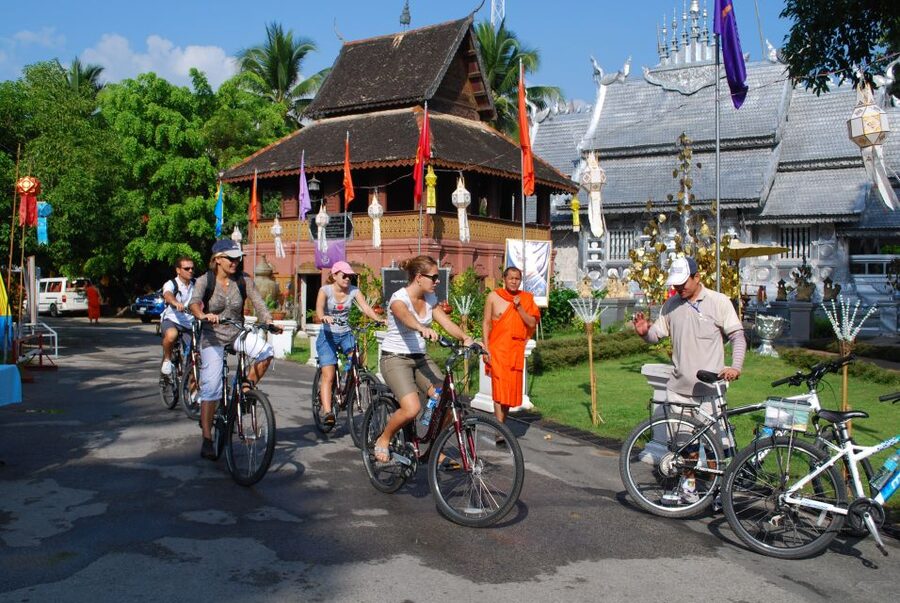
Temples look different from a bike. This half-day Chiang Mai City Culture ride takes you over quiet roads and small lanes around the old cultural center, so you see temples and markets without the stop-and-start of walking. I like how the route stays local, with everyday streets where you can spot people going about their day, not just tourist corners.
Two things really win me over: first, the temple stops are tied to clear stories, including legendary Buddha history at Wat Chedi Luang. Second, the pacing feels smart because you are covered by an English speaking guide who keeps things upbeat and practical, with names like Dong and Deo showing the kind of humor and careful bike handling you want.
One consideration: you have to dress for temple visits. That means long pants and no shorts or short skirts, and there is also a silversmith stop where you watch the craft, not shop.
In This Review
- Key highlights worth planning around
- Why bike the old city of Chiang Mai at all?
- Price and what your $43 really buys you
- The route in real life terms, 25 km with temple and market rhythm
- Wat Chedi Luang, the 14th-century landmark and the Emerald Buddha thread
- Wat Phra Singh and the Buddha statue that gives the name
- Wat Srisuphan and the Silver Temple, where craft and renovation meet
- China Town of Chiang Mai, flower markets, and the food-city connection
- The local market break, exotic fruits and Thai snack time
- Temple dress code, bike comfort, and how the group pace really feels
- Who this Chiang Mai culture bike ride is for
- Should you book the Chiang Mai City Culture Bicycle Ride?
- FAQ
- How long is the Chiang Mai City Culture bicycle ride?
- How far do you cycle during the tour?
- Where do you meet the guide, and where does the tour end?
- What languages are available for the guide?
- What is included in the tour price?
- What should I wear since the tour includes temples?
- Is the silversmith stop a shopping stop?
- Does the tour operate if I am traveling alone?
Key highlights worth planning around
- Wat Chedi Luang and the Emerald Buddha story you hear on the ride
- Wat Phra Singh stop, with the temple’s key Buddha statue context
- Wat Srisuphan and the adjacent Silver Temple craft scenes
- China Town of Chiang Mai through a flower market area
- Local market time for exotic fruits and/or Thai snacks
- Small group cycling over about 25 km of inner-city lanes
Why bike the old city of Chiang Mai at all?
I get it. You can always hire a tuk tuk, hire a guide, and do temples the traditional way. But cycling changes what you notice, and in Chiang Mai it is a big deal. On a bike, you move slowly enough to look, but fast enough to connect multiple places without feeling like you are repeating the same walk routes.
You also get a more human view of the city. This ride is built around quiet roads, alleyways, and lanes around the cultural center, so you are not only watching temple façades. You pass through the spaces where daily life keeps going, and that makes the whole afternoon feel grounded.
The half-day length matters too. Four and a half hours is long enough to cover multiple top sites, but short enough that you can still enjoy the rest of your day. If your Chiang Mai plan includes markets or a night food walk, this tour is a solid morning or early afternoon anchor.
A few more Chiang Mai days to weigh up
- Half-Day Thai Cooking Class at Organic Farm in Chiang Mai
★ 5.0 · 19,087 reviews - Chiang Mai: Elephant Sanctuary, Waterfall & Bamboo Rafting
★ 4.9 · 9,160 reviews - Chiang Mai: Doi Inthanon National Park Eco-Friendly Tour
★ 4.6 · 6,667 reviews
Price and what your $43 really buys you
At $43 per person for about 4.5 hours, you are paying for more than a bicycle. You are also buying three things that can easily cost extra on your own: a guide, entrance fees, and a meal or snack.
Included basics you should value:
- Bicycle and helmet
- English speaking guide (also offered in Thai and Dutch)
- Entrance fees
- Thai meal or snack plus water or soft drinks
- Insurance
That bundle is why the price feels fair. When you add up helmet, organized stops, and guide time plus entrances, you often end up paying similar money while doing less. Here, you get a curated route that also includes food and drink, so the ride does not turn into a constant expense chase.
This also helps with “time confidence.” You do not have to figure out the order of temples, the right lane to take, or how to time the market break. You just show up, pedal, listen, and eat when the tour schedule provides the chance.
The route in real life terms, 25 km with temple and market rhythm
This is a 25 km ride, mostly on quiet roads and small lanes. You spend a good portion of the afternoon cycling as much as possible, then you switch to short temple and market visits where the guide brings context.
The tour movement has a clear rhythm:
- Start and get into the old-city flow, then hop from one cultural stop to the next
- Keep riding through narrow lanes, not wide roads
- Stop frequently enough to absorb what you are seeing, without turning the day into a long slog
- Include a food break at a local market after the Chinatown-style area
One detail I like: you also cycle through parts of the city where regular street life shows up. That means you are not only photographing stone and gold leaf, you are watching how Chiang Mai lives around those landmarks.
Because you are on lanes and alleyways, expect tight turns and compact spaces. If you are new to bikes in traffic environments, choose the helmet and ride posture you are comfortable with, then let the guide set the pace.
Wat Chedi Luang, the 14th-century landmark and the Emerald Buddha thread
Wat Chedi Luang is the kind of place you remember because of its sheer presence. You visit it during this ride, and the stop is built around a specific story you do not get when you just pass by.
The temple was built in the 14th century, and your guide connects it to Thailand’s most revered Buddha statue, the Emerald Buddha. Here is the core legend you will hear: the Emerald Buddha used to reside at Wat Chedi Luang, then the Laotian king took it to Luang Prabang around 1545. These days, the Emerald Buddha is in Bangkok’s Wat Phra Kaew.
That backstory changes how you look at the temple grounds. You stop treating it like a scenic ruin and start treating it like a chapter in a much bigger regional story. Even if you are not a hardcore temple-history person, the narrative makes the visit feel purposeful.
Practical tip: since you are on a bike, the timing matters. You are not just dropped at the entrance and rushed. You get time to see what is going on at the site before moving on, which keeps the whole afternoon from feeling like a checklist.
Same stretch of coast, a different sort of day:
- Chiang Mai: Elephant Sanctuary & Waterfall Group Tour
★ 4.9 · 5,780 reviews - Chiang Mai: Chiang Rai Temples, Karen Tribe and Hot Springs
★ 4.7 · 5,401 reviews - Chiang Mai: Cooking Class, Market & Thai Herbs Garden Tour
★ 4.9 · 4,824 reviews - Chiang Mai: Authentic Cooking Class with Market & Farm Visit
★ 4.9 · 4,546 reviews
Wat Phra Singh and the Buddha statue that gives the name
Not far from Wat Chedi Luang, you make another key temple stop: Wat Phra Singh. This is often described as Chiang Mai’s most visited and beautiful temple, and part of that reputation comes from how your guide frames its centerpiece.
Wat Phra Singh is associated with an important Buddha statue called Phra Buddha Sihing, and that statue is what gives the temple its name. When you hear that explanation on location, the place feels less like random ornamentation and more like a shrine organized around one defining object.
This stop also helps balance the earlier one. Wat Chedi Luang tells a story with a wider historical reach, while Wat Phra Singh feels more focused on identity and reverence inside the Chiang Mai tradition.
If you are sensitive to crowded spaces, consider that temple areas can get busy. Cycling helps you arrive with a plan, but still, expect people around you in the temple zone.
Wat Srisuphan and the Silver Temple, where craft and renovation meet
One of my favorite parts of this ride is the craft angle. Before you get into the bigger temple stops, you visit a silversmith workshop where jewelry is fabricated in different shapes and sizes. The important expectation to set: no shopping here. It is for observation, not retail time.
Adjacent to that workshop is the Silver Temple area, where you see monks keeping busy making decorations using alloy that is part of the renovation work for the temple. That detail is the kind of thing you would miss on a standard temple tour. Instead of only seeing finished results, you see the making and the ongoing work.
Why this matters for your trip: Chiang Mai is full of beautiful things, but the best way to understand a place is to watch how it gets made. This workshop and temple craft stop gives you that “in-progress” perspective without needing to hunt it down yourself.
Also, it keeps the afternoon from becoming only stone and scenery. You get texture, process, and a sense of what hands are doing today, not just what stood centuries ago.
China Town of Chiang Mai, flower markets, and the food-city connection
After the main temple cluster, the ride heads into the outer circle area of the center where you visit a fresh and flower market. This area is referred to as the China Town of Chiang Mai, and the point of the stop is to show you the North’s flower scene up close.
You are not there to admire flowers like a museum display. You are there while the market energy is active, and your guide explains what you are seeing as you move through the stalls and surrounding lanes.
This portion also connects culture to commerce. Temples matter, yes, but so does what people buy, grow, and trade daily. It is a nice break from strict temple etiquette, since you get to focus on objects, colors, and the way local shopping works.
Then you cycle onward, crossing the river before stopping again at a local market. That sets you up for the most relaxing part of the ride, the one where you eat.
The local market break, exotic fruits and Thai snack time
One of the most practical parts of this tour is that it builds a proper reset into the schedule. After the Chinatown-style flower area, you stop at a local market and get more time to understand what is for sale.
This is when you may taste exotic fruits and/or local snacks, guided by the person leading you. Even if you are not sure which things you will like, you are not doing the trial-and-error alone. Your guide can point you toward options that make sense for first-timers.
The tour also includes a Thai meal or snack overall, plus water or soft drinks. That is a simple but smart inclusion, because it keeps the ride comfortable and helps you avoid the usual trap of getting hungry at the wrong moment.
Timing note: since this is a half-day, that market break is not endless. Use it. Eat something, hydrate, then get back on the bike with legs recharged.
Temple dress code, bike comfort, and how the group pace really feels
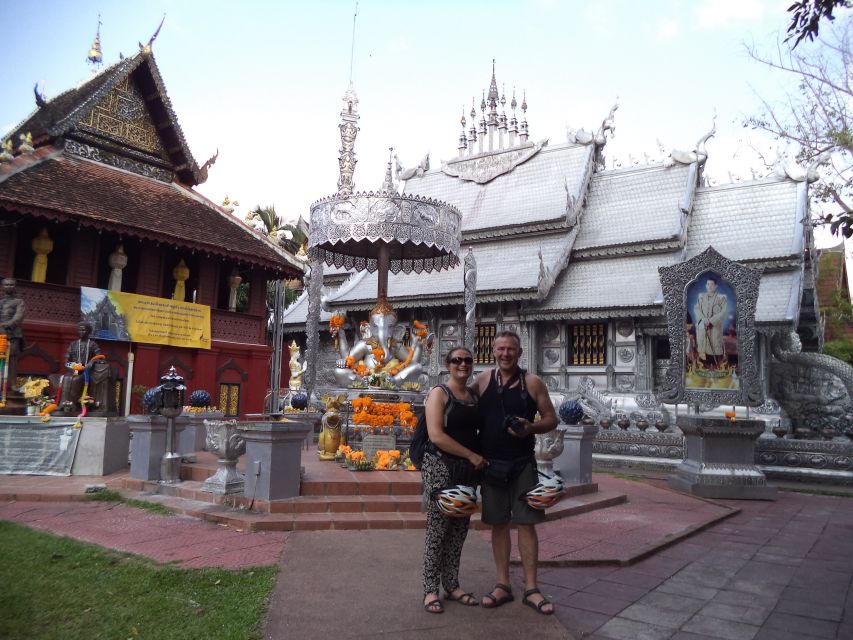
Because you visit temples during the tour, you must dress appropriately. Bring long pants. Shorts and short skirts are not allowed. This is not optional, and it is one of the easiest ways to make your day go smoothly. Pack long pants even if your Chiang Mai evenings are warm.
On the bike side, you will get a bicycle and a helmet. That takes one worry off your list. The guide also keeps things safe and controlled, with a cautious approach to riding that helps the group feel comfortable.
Small group cycling is part of the value here. When you are not in a massive pack, you can actually follow instructions, stop where needed, and still enjoy the streets instead of feeling trapped behind strangers.
What about fitness? You are cycling about 25 km. The tour is designed to be manageable for most people who can handle a half-day bike ride, but it is still effort. If you are coming in with sore legs or you are planning to hike later the same day, plan your rest around this.
Who this Chiang Mai culture bike ride is for
This tour is a great fit if you want a balanced mix of top temples and local markets, without spending your whole day in transit or losing time to route figuring. It is also a strong option if you like learning while moving, since the guide ties stories to each stop.
It is especially good if:
- You want to see Wat Chedi Luang, Wat Phra Singh, and Wat Srisuphan in one organized loop
- You prefer quiet lanes and small streets over larger roads
- You like market breaks where you can try foods like exotic fruits and local snacks
- You are traveling solo and still want company, since the tour is designed for individuals, with small-group operation
You might want to skip it if:
- You are not willing to follow the temple dress rule (long pants only)
- You only want shopping time and expect a silversmith stop to include purchases, because the craft visit is observation-focused
Should you book the Chiang Mai City Culture Bicycle Ride?
If you want a compact Chiang Mai afternoon with real local flavor, I think this one is worth booking. The best value is how the tour combines temples with street-level market time, all while you are moving efficiently on a bike. You also get a thoughtful included bundle, bike plus helmet, guide plus entrance fees, and food plus drinks.
Book it if your priorities include:
- A guide-led story at major temple sites like Wat Chedi Luang
- A craft stop at Wat Srisuphan and the Silver Temple area where monks are actively making decorations
- A market break with the chance to taste exotic fruits or local snacks
Before you go, just do two things: pack long pants for temple etiquette, and treat the silversmith stop as a watching experience, not a shopping spree.
If those are easy for you, you will likely enjoy this as one of your most efficient and character-rich half-days in Chiang Mai.
FAQ
How long is the Chiang Mai City Culture bicycle ride?
The ride lasts about 4.5 hours.
How far do you cycle during the tour?
You cycle about 25 km.
Where do you meet the guide, and where does the tour end?
You meet your guide at Recreational Chiang Mai Biking, and the tour ends back at the same meeting point.
What languages are available for the guide?
The guide is available in English, Thai, and Dutch.
What is included in the tour price?
The tour includes a bicycle and helmet, an English speaking guide, entrance fees, a Thai meal or snack, water or soft drinks, and insurance.
What should I wear since the tour includes temples?
You should bring long pants. Shorts and short skirts are not allowed.
Is the silversmith stop a shopping stop?
No. The silversmith visit is for viewing, and shopping is not part of that stop.
Does the tour operate if I am traveling alone?
Solo travelers are welcome, but the tour only operates with a minimum of 2 participants. If that minimum is not reached, the provider may offer a different time-slot/day/tour or cancel your reservation.
Newest Chiang Mai reviews on the site
- Tour with Hike in Kiew Mae Pan Natural Trail from Chiang Mai★ 4.8 · 26 reviews
- Chiang Mai: 22 km XC Mountain Biking from Sticky Waterfall★ 4.7 · 13 reviews
- Sticky Waterfall Half-day with Private Car★ 4.9 · 37 reviews
- Sticky waterfalls- Elephants- Bamboo or White water rafting.★ 5.0 · 9 reviews
- Red, Blue, White Temples & Hot Spring Trip from Chiang Mai★ 4.4 · 143 reviews
- Private Tour Pha Chor Canyon & Doi Inthanon National Park★ 5.0 · 23 reviews
- Private Tour Doi Inthanon, Trekking Kew Mae Pan Nature Trail★ 5.0 · 11 reviews
- Private Doi Inthanon, Nature Trail, Wat Phra That Doi Kham★ 5.0 · 6 reviews
City Tours, compared.
City Highlights Temple and Market Walking Tour
Read our review →
Guided Tour of Phuket City with Hotel Transfers
Read our review →
3 Hour Old City and Temples Guided Walking Tour
Read our review →
Phuket City Tour with Wat Chalong, Big Buddha & Famous Viewpoints
Read our review →
Travstore Original Phuket Discovery Tour – Shared Half Day City Tour
Read our review →
Historical City of Ayutthaya – Unesco Full Day Tour From Bangkok
Read our review →
Half-Day City Highlights and Viewpoints Group Tour
Read our review →Browse the lists this tour appears in